
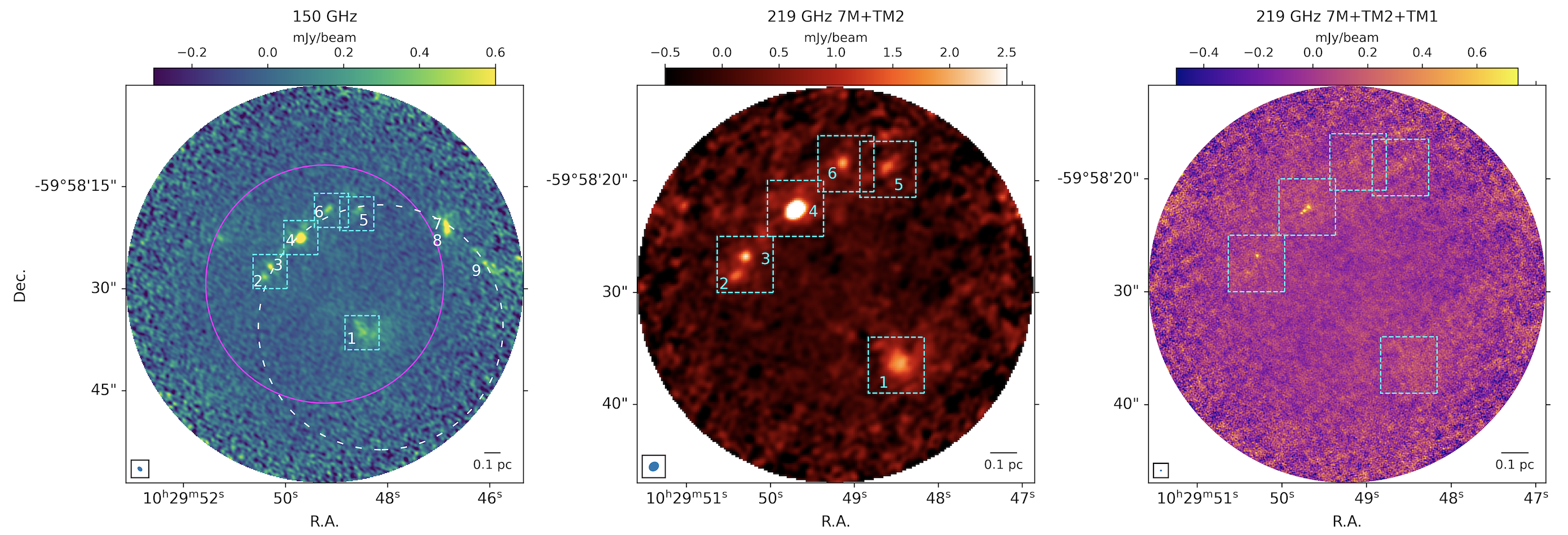
Several theoretical and observational studies have shown that new waves of triggered star-formation can be induced by the feedback from newly formed massive protostars, due to the expansion of H II regions. We used the millimeter dust continuum data of the ALMAGAL survey and the Anderson et al. 2014 catalog of H II regions to search for signatures of possible triggered star formation at its onset, and selected one ALMAGAL source for ALMA follow-up observations. For this study we selected the source AG286.0716-1.8229, in which six cores were detected at a resolution of ~7600 au, but only two at a higher resolution. The 4 cores not detected at higher resolution are prestellar core candidates. We used archival data from the SARAO Meerkat Galactic Plane Survey and Rapid Askap Continuum Survey to confirm whether an H II region is present in the field. We observed the source with with ALMA in Band 4, covering the emission of DCO+(2-1), N2D+ (2-1), DCN (2-1), and CH3CCH (9-8), to infer from the chemical composition and temperature estimates whether these cores are in an early phase of the star-formation process, which allows us to classify them as prestellar core.
The new Band 4 continuum image revealed additional three cores outside of the ALMAGAL field of view, for a total of 9 cores in the region, 8 of which are located along an arch of radius ~0.75 pc. We also used the continuum and molecular emission to estimate the mass of these cores, to determine whether they are gravitationally bound or transient objects. We have derived a spectral index between -0.14 and -0.4, in the frequency range of 0.8-1.6 GHz for the candidate H II region, which is consistent with optically thin free-free emission. The H II region spatially coincides (as projected on the plane of the sky) with the position of one of the cores, which in the new ALMA Band 4 observations does not have a compact morphology. The N2D+ and DCO+ emission peaks at the position of three out of four prestellar core candidates, and the overall emission in both the line and the continuum, which extends outside of the FOV of the ALMAGAL observations, reveals a clear arched shape centered at the H II region. We were able to estimate the gas temperature of only the most evolved core, using the CH3CCH emission. The resulting value of 39±5 K is also an upper limit for the other cores. Using plausible temperature ranges for each core, based on the information from chemical tracers and the dust continuum, we derived mass ranges for the cores (~2-16 M☉) as well as ranges for the virial parameter (~0.3-5). All the cores along the arch have virial parameters consistent with bound objects, with only one exception. Comparing the typical separation and mass of the cores with those expected in the case of the collect and collapse scenario and with the thermal Jean length and mass, the best agreement is found with the characteristic scales in the case of triggered star formation. The same methodology can be applied to further ALMAGAL sources to identify optimal targets to study a larger sample of prestellar cores in an environment affected by the presence of an H II region.


