
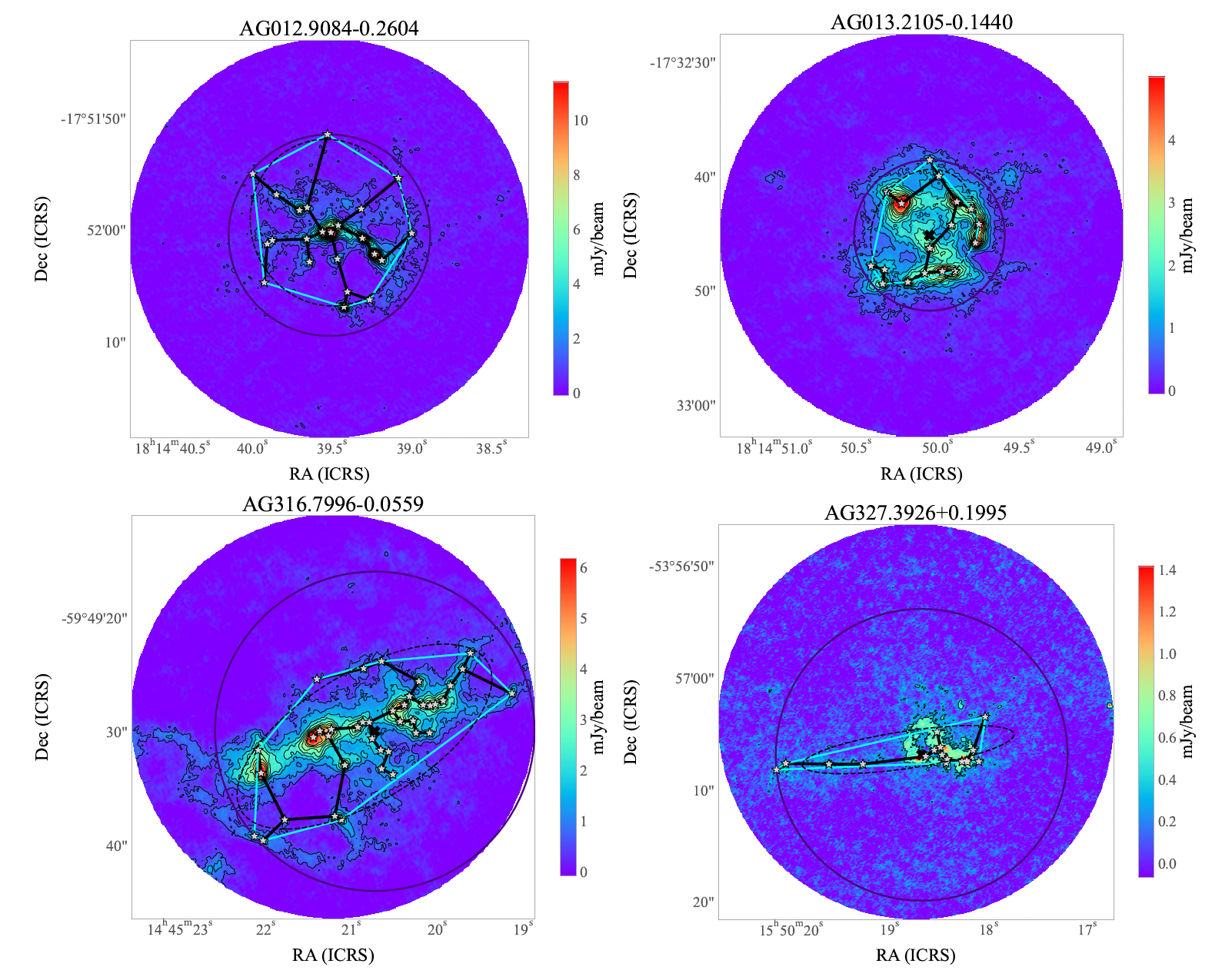
High-mass stars and star clusters form from the fragmentation of massive dense clumps driven by gravity, turbulence, and magnetic fields. The ALMAGAL project observed ∼1000 clumps at ∼1000 au resolution, enabling a statistically significant characterization of this process across a large range of clump physical parameters and evolutionary stages. In this work, we investigated the spatial distribution of dense cores in the 514 massive, potentially cluster-forming, clumps hosting at least 4 cores, to trace fragmentation's initial conditions and early evolution. We used quantitative descriptors, evaluated against the clump bolometric luminosity-to-mass ratio as an indicator of evolution. Core separations were measured with the minimum spanning tree method (MST) and compared with the Jeans gravitational fragmentation theory. We used the Q parameter and the mass segregation ratio, ΛMSR, to evaluate whether cores have specific arrangements or differences depending on their masses.
ALMAGAL cores are usually arranged in elliptical groups with an axis ratio e ∼ 2.2, but e ≥ 5 is also observed. A single characteristic core separation per clump is found in ∼76% of cases, but signatures of multiple fragmentation lengths not rare. Typical core separations are compatible with the clump-averaged thermal Jeans length, λthJ, though a population, typical of low-fragmented/young clumps, has wider separations with l ≈ 3×λthJ. The core separation decreases on average from l ∼ 22000 au in younger systems to l ∼ 7000 au in more evolved ones. Cores are typically distributed in fractal-type subclusters, with centrally concentrated patterns appearing only at later stages, but without a progressive evolutionary transition. Finally, mass segregation is found in 110 systems, with its occurrence increasing with evolution.


